
Thursday, June 10, 2010
American Black Bear Size

Sunday, June 6, 2010
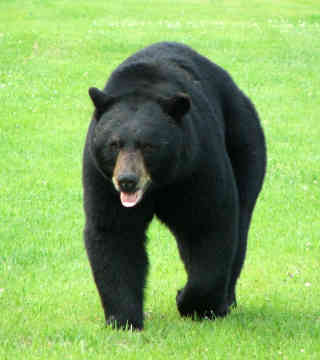
American Black Bear Build
Wednesday, June 2, 2010
American Black Bear Hybrids

In the ninth-year report has found that the bears are seen in the Zoological Gardens to couple freely, but previously to 1848 most had rarely conceived In the Reports published since this date three species have produced young (hybrids in one case).
A huge black bear was shot in Autumn 1986 in Michigan, for which some thought was a hybrid of black bear and grizzly bear, due to its unusually large size and its proportionately larger braincase and skull. DNA tests failed to show whether it is a black bear or grizzly bear.
Friday, May 28, 2010
American Black Bear Subspecies
| Sub-Species Name | Common Name | Distribution | Description | |
|---|---|---|---|---|
| Ursus americanus altifrontalis | Found in the Pacific Northwest coast from central British Columbia through northern California and inland to the tip of northern Idaho and British Columbia | |||
| Ursus americanus amblyceps | Native to Colorado, New Mexico, west Texas, the eastern half of Arizona into northern Mexico; southeastern Utah | |||
| Ursus americanus americanus | Found in eastern Montana to the Atlantic coast; from Alaska south and east through Canada to the Atlantic and south to Texas. Thought to be increasing in some regions. | |||
| Ursus americanus californiensis | Found in the mountain ranges of Southern California, north through the Central Valley to southern Oregon | |||
| Ursus americanus carlottae | Haida Gwaii Black Bear | Haida Gwaii/Queen Charlotte Islands and Alaska | Generally larger than its mainland counterparts with a huge skull and molars, and is only found as a black color phase | |
| Ursus americanus cinnamomum | Cinnamon Bear | Idaho, western Montana, and Wyoming, eastern Washington and Oregon, northeastern Utah | Has brown or red-brown fur, reminiscent of cinnamon. | |
| Ursus americanus emmonsii | southeastern Alaska. Stable. | Distinguished by the fur of its flanks being silvery gray with a blue lustre | ||
| Ursus americanus eremicus | northeastern Mexico. Endangered. | |||
| Ursus americanus floridanus | Florida Black Bear | Florida, southern Georgia, and Alabama. Threatened in Florida as the Florida Black Bear (state list). | Has a light brown nose, and shiny black fur. A white chest patch is also common. An average male weighs 299 pounds (136 kg) | |
| Ursus americanus hamiltoni | Newfoundland Black Bear | Newfoundland | Generally bigger than its mainland relatives, ranging in size from 90 to 270 kg and averaging 135 kg. It also has one of the longest hibernation periods of any bear in North America | |
| Ursus americanus kermodei | Kermode Bear, Spirit Bear | Central coast of British Columbia | Has white fur due to a rare genetic trait | |
| Ursus americanus luteolus | Louisiana Black Bear | Eastern Texas, Louisiana, southern Mississippi. Threatened (federal list). | A subspecies with a relatively long, narrow, and flat skull, and proportionately large molar teeth | |
| Ursus americanus machetes | North-central Mexico | |||
| Ursus americanus perniger | Kenai Peninsula, Alaska | |||
| Ursus americanus pugnax | Alexander Archipelago, Alaska | |||
| Ursus americanus vancouveri | Vancouver Island, British Columbia |
Monday, May 24, 2010
Taxonomy and evolution
Although they all live in North America, American black bears, brown bears, and polar bears are not closely related, genetic studies have revealed that they split from a common ancestor before about 5,05 million years. Both American and Asiatic black bears are considered sister taxa, and are more related to each other than other bears species.
A small primitive bear called Ursus abstrusus is the oldest known North American fossil member of the genus Ursus, dated to 4.95 millions years ago. This suggests that U. abstrusus may be the direct ancestor of the American black bear, which evolved in North America. Although Wolverton and Lyman still consider U. vitabilis an "apparent precursor to modern black bears", it has also placed within U. americanus.
Ancestor of the American black bear and the Asian black bear diverged from sun bears 4.58 million years ago. Then the American black bear separated from the Asian before about 4.08 million years ago. The earliest fossils of American black bears, which are located in Port Kennedy, Pennsylvania, greatly resemble the Asiatic species, though later specimens grew to sizes comparable to grizzlies. From the Holocene to present, American black bears seem to have shrunk in size, but this was rejected due to issues of aging of the fossil samples.
American black bear lived in the same period as as short-faced bears (Arctodus simus and A. pristinus) and the Florida spectacled bear (Tremarctos floridanus). These Tremarctine bears evolved from bears that had emigrated from Asia to North America 7–8 millions years ago. The short-faced bears are thought to have been heavily carnivorous and the FL spectacled bear more herbivorous, while the American black bears remained arboreal omnivores, like their Asian ancestors. The black bear's generalist behavior allowed it to exploit a wider variety of foods and has been given as a reason why of these 3 genera, is the only survived climatic and vegetative changes during and after the Ice Age, while others more specialized North American predators extinct. However, both Arctodus and Tremarctos had survived several other ice ages. After these prehistoric Ursids went extinct during the last glacial period 10,000 years ago, black bears are probably the only bears in much of North America, while brown bears did not come into the rest of continent.
Subscribe to:
Posts (Atom)